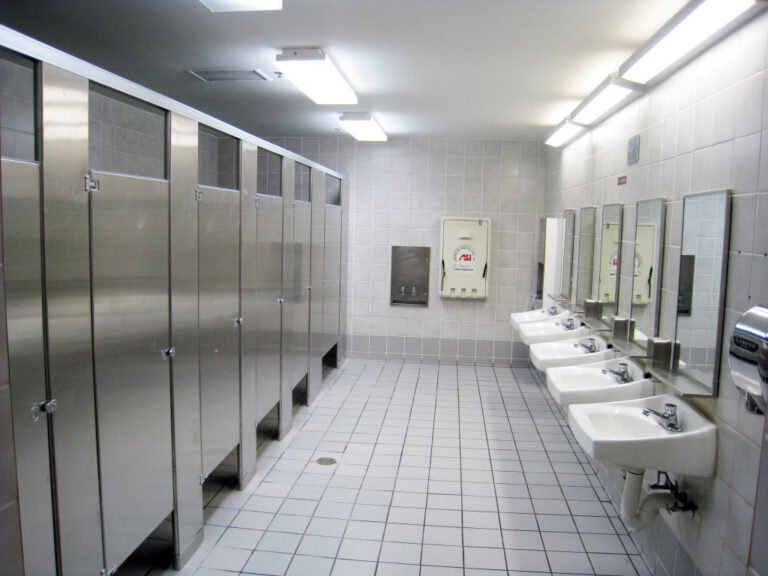
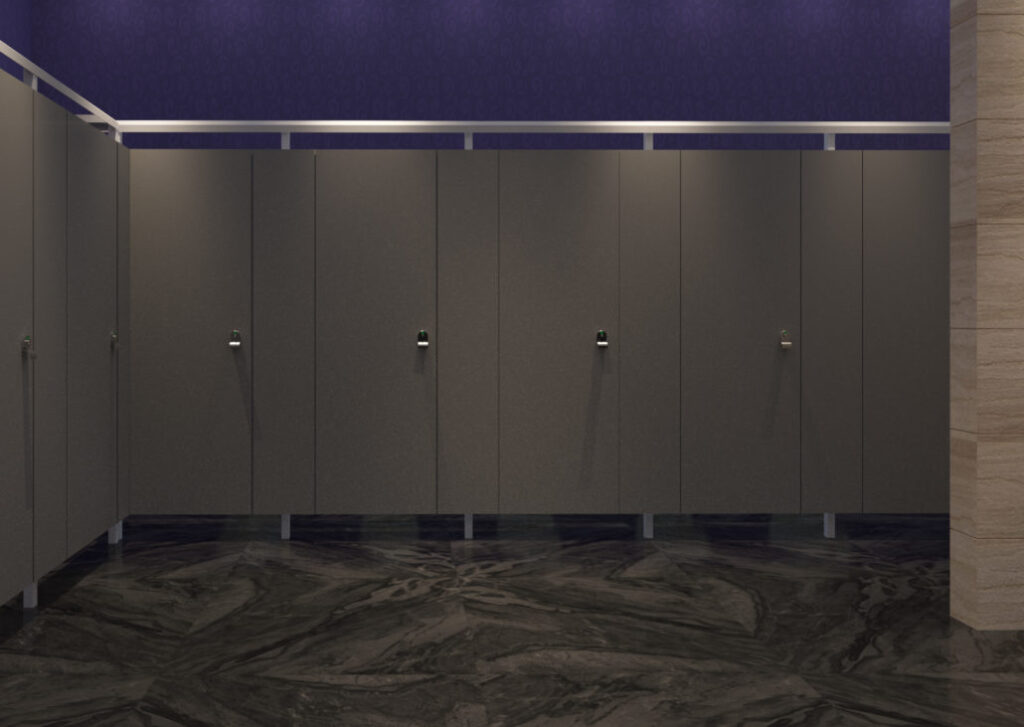
Phenolic toilet partitions cost more than steel or high-pressure laminate — often noticeably more. In wet rooms, gyms, stadiums, and restrooms running several hundred users a day, facility managers keep specifying them anyway, because the replacement they avoid is worth more than the premium they pay.
This post covers what’s actually inside a phenolic panel, why moisture destroys every other material first, how black-core and color-through differ once they’re installed, and what to check before your submittal goes out.
What a phenolic panel actually is
Solid phenolic is layers of kraft paper saturated in phenolic resin, then fused under heat and pressure into one solid slab. A decorative melamine face bonds on in the same press.
That manufacturing detail is the whole product. There is no core material wrapped in a skin, no edge banding holding a laminate down, and no honeycomb void behind the face. Nothing can delaminate because nothing was laminated on — the panel is one piece.
Compare that to the two materials phenolic usually beats out:
- Powder-coated steel is a honeycomb cardboard core inside two sheets of formed steel with baked enamel on the outside. Chip the enamel near a fastener and moisture gets to raw steel.
- High-pressure laminate (HPL) is a decorative laminate glued to a particleboard core, with edge banding sealing the perimeter. The edge banding is the weak point; once water gets behind it, the core swells and the face lifts.
Typical phenolic thicknesses run 3/4″ (19 mm) doors and pilasters with 1/2″ (13 mm) panels, though several manufacturers offer 3/4″ panels for maximum-abuse jobs.
Why wet rooms punish every other material first
Water is what separates the materials, and it doesn’t attack the face — it attacks the edges, the fasteners, and the bottom two inches.
Steel rusts from the inside out once the coating is breached, and the breach usually happens where the hardware bolts through.
Laminate delaminates when moisture creeps behind edge banding, which mop water and humidity both accomplish eventually.
Solid plastic (HDPE) genuinely holds up in wet conditions — it’s homogeneous polymer, it can’t rust or swell, and for pools and school locker rooms it’s often the smarter buy. Where it gives ground to phenolic is rigidity and finished appearance: HDPE is softer, shows scuffs and gouges at eye level, and doesn’t offer the same finish range.
Phenolic ignores water because the resin runs through the entire slab rather than sitting on the face. Trim a phenolic panel in the field and the cut edge is the same water-resistant material as the rest of it. That’s not true of any core-and-skin product.
Two field practices make the difference real:
- Hold the panels up off the slab. Floor-mounted phenolic set an inch or so above the finished floor keeps the bottom edge out of standing water and lets the floor drain and squeegee clean. Several manufacturers offer tall privacy configurations running up to 120″ high on that setup.
- Watch the shoes and the fasteners. In a wet room, stainless hardware and stainless pilaster shoes are worth the upcharge. The panel outlasting its own fasteners is a real and avoidable failure.
Graffiti behaves the same way as water. The dense, non-porous surface releases marker and paint with a solvent wipe, and quality phenolic won’t ghost the way a porous surface does. That single property is what drives phenolic onto school district and transit-hub retrofits more than any durability spec.
Black-core vs. color-through: what the panel edge tells you
Two tiers, and the difference shows up at every joint.
Phenolic Black Core Toilet Partitions carries your selected color on the face and a black core throughout. Every exposed edge reads as a black stripe. This is the industry workhorse and the better value on most jobs — and on a dark or neutral palette, the black edge reads as a deliberate reveal line rather than a compromise.
Color Thru Phenolic Toilet Partitions carries the same color from face to edge, so there’s no stripe at the joints. It costs meaningfully more than black-core — commonly quoted around 25–40% more, though the spread moves with color, quantity, and lead time — and color-through lines often carry a higher standard fire rating.
Pick color-through when the architect is chasing a monolithic look and the finish is part of the design narrative. Pick black-core when the building is being run on lifecycle cost, which is most of the time.
Phenolic vs. the alternatives at a glance
| Solid phenolic | Solid plastic (HDPE) | High-pressure laminate | Powder-coated steel | |
|---|---|---|---|---|
| Moisture resistance | Excellent — resin through the slab | Excellent — won’t rust or swell | Poor in wet rooms; edges fail first | Fair; rusts once coating chips |
| Impact / rigidity | Excellent, very rigid | Very good; dents instead of cracking | Fair | Fair; dents and creases |
| Graffiti cleanup | Excellent, non-ghosting | Very good | Fair | Fair |
| Finish range | Wide | Limited solid colors | Widest | Moderate |
| Relative cost | High | Mid | Low–mid | Lowest |
| Typical fit | Wet rooms, stadiums, transit, healthcare, K-12 | Pools, school locker rooms, parks | Dry office and retail restrooms | Dry, low-abuse, budget work |
Read that table as a moisture-and-abuse decision, not a quality ranking. In a dry Class A office restroom with light traffic, laminate is the right call and phenolic is money spent on a problem that building doesn’t have. In a shower-adjacent locker room, laminate is a warranty claim with a date on it.
Three spec lines contractors miss until submittal review
Flame spread and smoke developed. Phenolic lines are typically tested to ASTM E84, and the rating varies by product family — several black-core lines are Class B standard with Class A available, while color-through often lands Class A as standard. Pull the specific numbers for the exact model you’re quoting; a Class A requirement in the spec can quietly move you to a different product family or a surcharge.
Warranty — and what it actually covers. Warranty terms vary widely across manufacturers, from a few years against delamination to 25 years covering delamination, breakage, and corrosion. Those are not the same promise. Compare the covered failure modes, not just the number of years, and check whether the warranty is voided in continuously wet or chemically cleaned environments.
Mounting style. Phenolic supports all four standard configurations — floor-mounted overhead-braced, floor-to-ceiling, ceiling-hung, and floor-mounted without a headrail. Ceiling-hung is the sanitation favorite because nothing touches the floor and the whole slab mops in one pass, but it’s the one that punishes you if the structure above wasn’t planned for it.
Field notes worth catching before demo day
Ceiling-hung needs real structure. A standard T-bar grid will not carry partitions. Ceiling-hung phenolic needs steel or blocking engineered above the ceiling, and if that wasn’t in the framing package, the GC is looking at rework before your material lands. Catch this at shop drawing review, not at delivery.
Floor-anchored needs slab depth.
Anchors need adequate penetration into sound concrete — commonly around 2″. Thin topping slabs, post-tensioned decks, and radiant tubing all change the answer, and all three are common in NY-metro renovation work.
Phenolic is heavy and unforgiving.
It’s denser than laminate and won’t tolerate sloppy field cutting. Field measure before you order, and order oversized where a wall is out of plumb rather than hoping to scribe a fused resin panel on site.
Order a spare door. Anchors need adequate penetration into sound concrete — commonly around 2″. Thin topping slabs, post-tensioned decks, and radiant tubing all change the answer, and all three are common in NY-metro renovation work.
What this means for your project
If your restroom is wet, high-cycle, or a known vandalism target — locker rooms, stadiums, transit hubs, K-12, high-volume retail — phenolic usually pays back inside one avoided replacement cycle. If it’s a dry, light-traffic office or retail restroom, the premium buys you very little and laminate or steel is the honest recommendation.
The real decision isn’t phenolic yes-or-no. It’s phenolic where the building actually punishes material, and something cheaper everywhere else in the same package — which is exactly the kind of split a takeoff should show you before you bid.
Read more about:
- Hadrian Phenolic-Core Toilet Partitions
- Metpar Phenolic Color Thru Toilet Partitions
- Metpar Phenolic Black Core Toilet Partitions
- Metpar Solitude Phenolic Toilet Partitions
- Bradley Phenolic Privacy Toilet Partitions
Phenolic Toilet Partitions: Why Wet Rooms and High-Traffic Restrooms Still Spec Them: frequently asked questions
In wet rooms, gyms, stadiums, schools, and transit restrooms, generally yes — the long warranties on quality phenolic outlast two replacement cycles of laminate. In a dry, low-traffic office restroom, the premium buys durability the building will never use, and laminate or powder-coated steel is the better value.
Black-core shows a black stripe at every exposed edge and carries your color on the face only. Color-through carries the color through the full slab, so joints read monolithic. Color-through costs more and often carries a higher standard fire rating; black-core is the lifecycle-cost workhorse.
Yes — all four mounting styles support accessible stall layouts. You still need your architect to verify clear floor space, door approach clearances, grab-bar blocking, and the ambulatory stall dimensions against the 2010 ADA Standards plus any stricter NYC, New York State, New Jersey, or Connecticut requirements. The design professional of record owns compliance.
A standard six-stall restroom in overhead-braced phenolic typically runs one to two crew days once material is on site and the walls are ready. Ceiling-hung adds time, and adds a lot more if structural blocking wasn’t roughed in during framing.
Deep gouges can’t be filled invisibly, so the practical repair is one-for-one panel replacement. Because the color is integral rather than painted on, there’s no touch-up step — which is why keeping a spare door on site is worth the line item on high-abuse projects.
Spec it once, with someone who installs it
Mavi New York supplies and installs toilet partitions — phenolic, solid plastic, laminate, steel, and stainless — throughout the New York metro area, New Jersey, and Connecticut. Send us your drawings and we’ll put together a takeoff that shows where phenolic earns its premium on your job and where it doesn’t.
- Visit/Call Us: 5102 21st St, 6th Floor, Long Island City, NY | 718-874-3805
- Email Our Estimators: info@mavinewyork.com
- Request an Estimate Online: Get a Free Quote