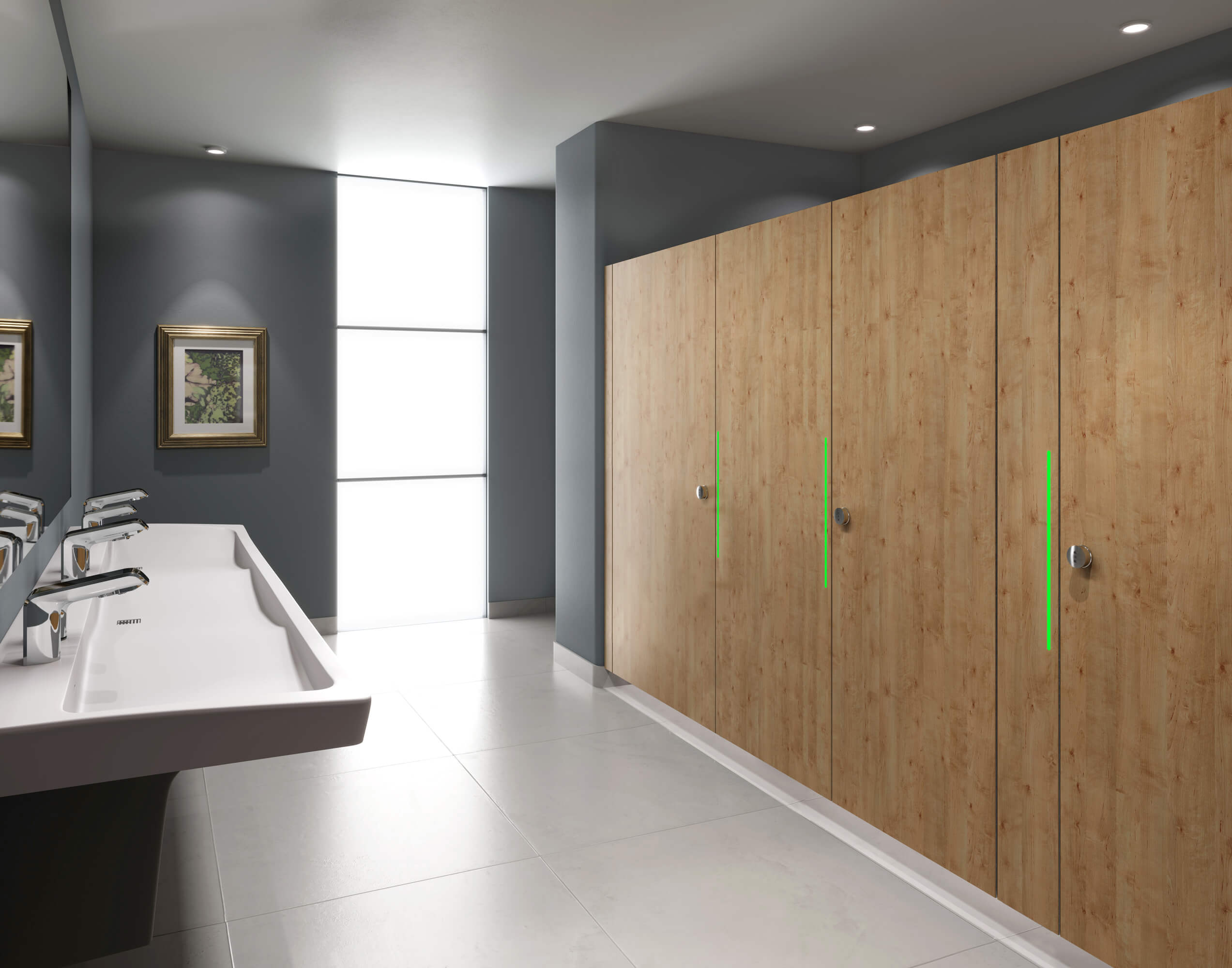
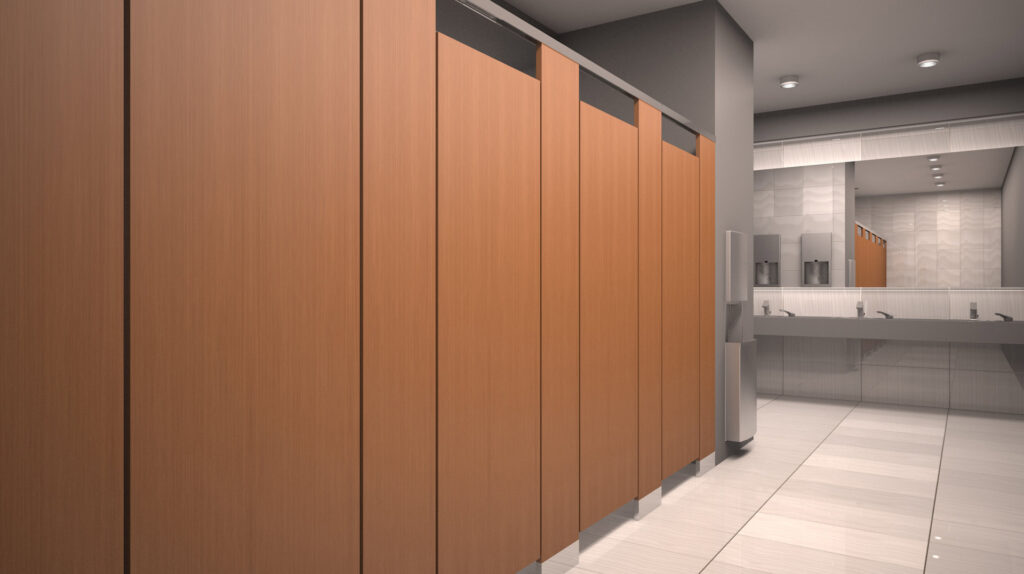
If you’re budgeting a restroom for an office, school, gym, or retail space in New York City, the partition line item usually raises the same question: what do commercial toilet partitions cost, really — and why does one quote come in at $600 a stall and another at $3,000?
The short answer: material choice drives most of the spread, and installation conditions in NYC drive the rest. This guide breaks down realistic per-stall price ranges by material, what installation adds, and the factors that move your number up or down — so the quotes you collect actually make sense.
The Quick Answer: Cost per Stall by Material
A “stall” here means one complete compartment: panels, a door, pilasters (the vertical posts that support everything), and hardware. Here is how common materials compare on material cost per stall, before installation:
| Material | Material Cost per Stall* | Best Fit |
|---|---|---|
| Powder Coated Steel | From $510 | Offices, budget-driven jobs, moderate traffic |
| Plastic Laminate (HPL) | Budget | Dry restrooms where color/finish options matter |
| Solid Plastic (HDPE) | Mid, lowest lifetime cost | Schools, gyms, pools — wet and high-abuse areas |
| Stainless Steel | From $965 | Corporate, hospitality, upscale retail |
| Phenolic Black Core | Mid | Stadiums, transit, healthcare — heavy traffic |
| Solid Surface / European Style | Premium | Design-led hotels, Class A office, maximum privacy |
*Starting prices reflect Mavi New York’s in-stock, single-stall overhead braced configurations. Multi-stall runs, ADA stalls, and custom sizes change the per-stall math — usually downward per stall as quantity goes up, upward for ADA and custom work.
The pattern is consistent: powder coated steel is the economical workhorse, HDPE and phenolic cost more up front but shrug off water and abuse, and stainless, solid surface, and European-style systems sit at the top because you’re paying for finish and privacy, not just function.
What Installation Adds in NYC
Installation is typically quoted separately from material, and in New York City it’s a bigger share of the total than in most markets.
What Moves That Number:
- Mounting Style: Overhead braced partitions — the ones with an aluminum headrail running across the top — are the fastest to install and the most economical. Ceiling hung and floor-to-ceiling systems need structural support above the finished ceiling, which means coordination with other trades and more labor.
- Site Conditions: A ground-floor restroom with freight access prices differently than a 40th-floor buildout where material moves through a service elevator on a scheduled window. After-hours work, occupied buildings, and union requirements all show up in the labor line.
- Demolition and Disposal: Removing existing partitions and carting them away is real work in NYC. Make sure every quote you compare either includes it or excludes it — this is the most common reason two bids look far apart.
- Wall and Floor Anchoring: Partitions anchor into what’s behind the tile. Solid block walls, metal studs with backing, or studs without backing each call for different fastening, and missing backing discovered mid-install is a change order waiting to happen.
ADA Stalls: Budget Them Separately
Every public restroom needs at least one accessible stall, and it isn’t just a wider door. An ADA-compliant compartment is larger, uses an out-swinging or sliding door, and needs grab bars and clear floor space that your architect will verify against current ADA standards. Plan on an ADA stall costing more than a standard stall in both material and layout space — and confirm the dimensions with your design professional rather than working from a rule of thumb, because clearances depend on your specific layout.
Why the Cheapest Quote Is Often the Expensive One
Two years in, the material decision comes due. Powder coated steel in a wet gym shower area will rust from the bottom edge up. HPL in a natatorium will delaminate. If the restroom sees water, harsh cleaners, or vandalism, HDPE or phenolic costs more on day one and less every year after — fewer repairs, no repainting, and graffiti that wipes off instead of needing replacement panels.
Stainless Steel
Premium & Elegant
Powder Coated Steel
Economical & Durable
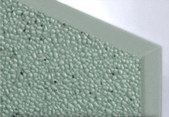
Solid Plastic (HDPE)
Waterproof & Tough
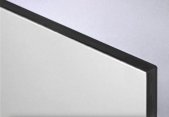
Phenolic Black Core
High-Traffic & Impact
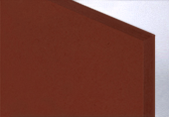
Color Thru Phenolic
Scratch & Damage Resistant
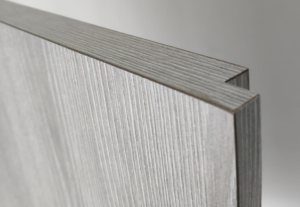
Plastic Laminate (HPL)
Diverse Color Palettes
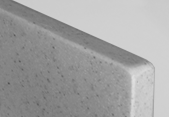
Solid Surface
Sophisticated & Architectural
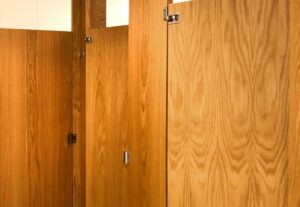
Wooden Partitions
Classic & Prestigious
How to Get an Accurate Number Fast
A real quote needs only a few things: the number of stalls, the configuration (between walls, corner, or freestanding), rough opening dimensions, the material you’re leaning toward, and a photo of the existing restroom if it’s a renovation. With that, an estimator can price material same-day and installation within a site visit.
If you’re a GC bidding from drawings, a Division 10 takeoff does the counting for you — stall counts, configurations, ADA stalls, and accessories, priced directly from the actual plans.