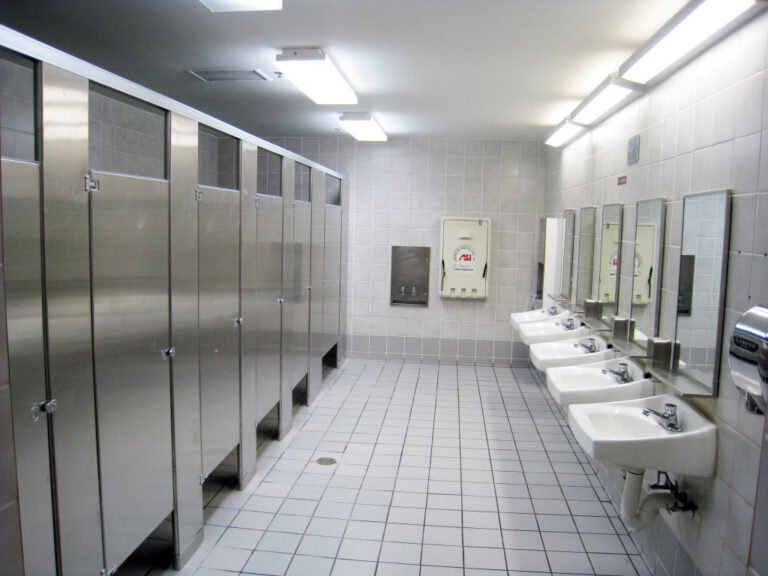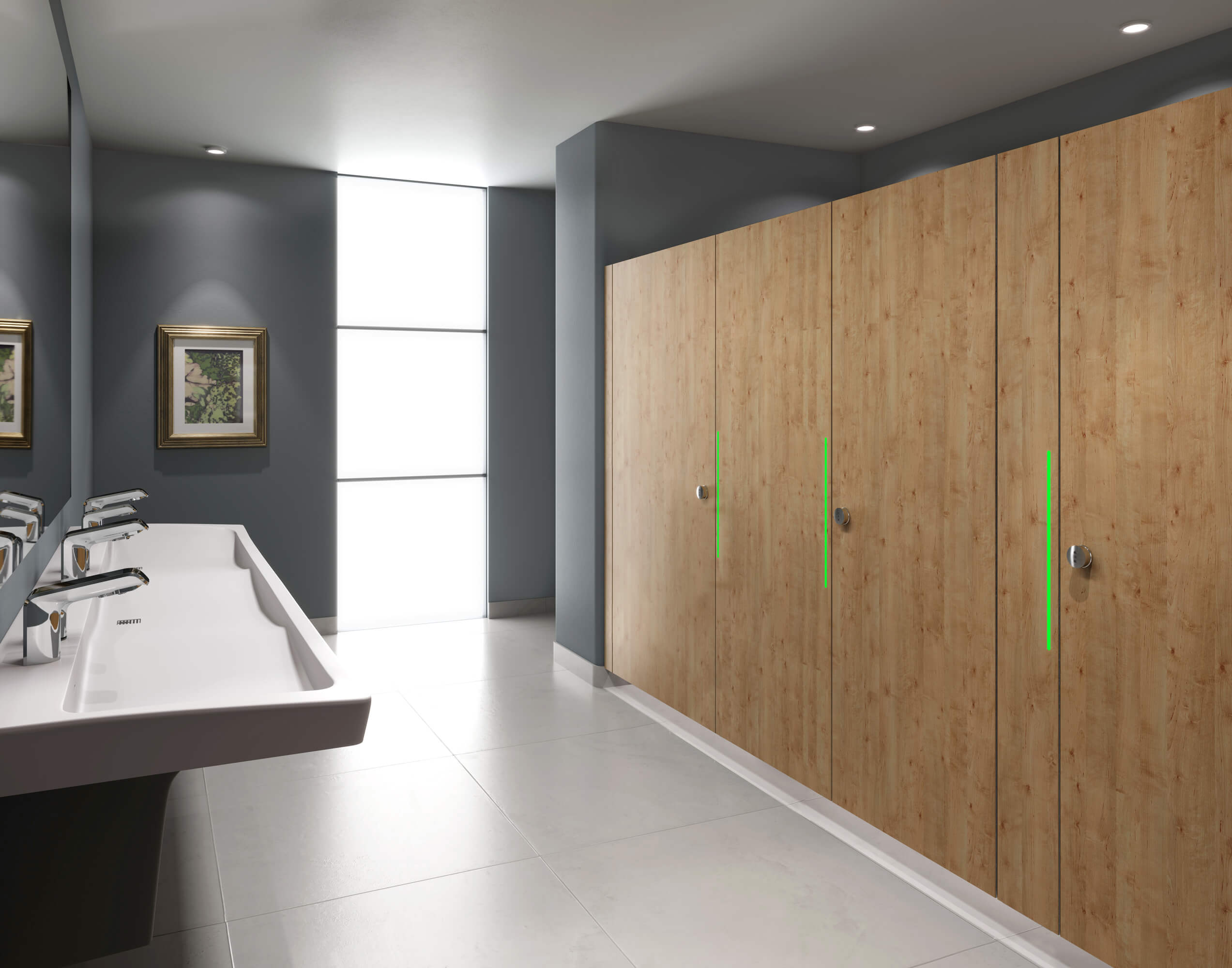

School restroom partitions live a harder life than partitions anywhere else. They get kicked, carved, tagged with marker, slammed a few hundred times a day, and then scrubbed with whatever the custodial closet has on hand. Two years after a renovation, the stalls will tell you whether the right material was specified — or whether the school bought the same problem twice.
This guide covers what actually holds up in a school restroom, how to deal with graffiti before it becomes a repainting budget, and how to get the work done inside a summer break. It draws on school partition projects Mavi New York has completed across the New York area — from Farmingdale High School to the U.S. Merchant Marine Academy.
What makes a partition “vandal resistant”?
Vandal resistance comes from the panel material, not from a marketing label. The question to ask about any partition is simple: what happens when a student kicks it, scratches it, or writes on it?
Solid plastic (HDPE) — high-density polyethylene, a solid one-inch panel with the color running all the way through — is the school standard for a reason. Scratches don’t expose a different-colored core, so carving initials into a door produces almost nothing to show off. The surface is non-porous, so marker and paint sit on top instead of soaking in. Panels dent and recover rather than crease, and they can’t rust, which matters in rooms that get mopped twice a day.

Powder-coated steel is the budget default in many buildings, but in a school it’s a short-term answer. The painted surface chips where it’s kicked, scratches show the metal underneath, graffiti bonds to the paint, and moisture finds the seams and starts rust creeping up from the floor.
Phenolic (a solid resin-and-paper core) is extremely rigid and performs well, but for most school restrooms HDPE delivers comparable durability at a lower cost — and cleans up graffiti more easily.
| Solid plastic (HDPE) | Powder-coated steel | Phenolic | |
|---|---|---|---|
| Kick and impact damage | Dents recover; no crease | Dents and chips show | Very rigid; edges can chip |
| Scratches and carving | Color-through; barely visible | Exposes bare metal | Exposes core color |
| Graffiti removal | Wipes off non-porous surface | Often needs repainting | Good, surface-dependent |
| Rust / moisture | Immune | Vulnerable at seams | Excellent |
| Typical school fit | The default choice | Low-traffic, budget-driven | Upscale or specialty areas |
The hardware matters as much as the panel. Continuous stainless steel wall brackets leave no gap to pry against, continuous (piano) hinges spread door abuse across the full height instead of concentrating it on two points, and through-bolted, tamper-resistant fasteners keep hardware from walking off during the school year.
Graffiti: removal beats repainting
On painted metal partitions, graffiti is a repainting problem. On HDPE, it’s a cleaning problem — and that difference shows up in the custodial budget every single year.
Because solid plastic is non-porous, most marker, pen, and paint comes off with standard non-abrasive cleaners; stubborn marks respond to solvent-based graffiti removers without damaging the panel, since there’s no painted finish to strip. Deeper scratches can often be dressed out of the panel surface rather than requiring replacement. Custodians can be aggressive with it — the panels tolerate power washing.
A practical tip from the field: darker panel colors and textured finishes hide both scratches and residue better than smooth light colors. If graffiti is a recurring problem in a particular building, that’s worth weighing when the color is picked — before the submittal, not after.
Installing school restroom partitions in the summer window
Almost every school partition project in New York runs on the same calendar: the building empties in late June and must be ready before staff return in late August. That window is real, but it’s shorter than it looks — the same weeks are when flooring, painting, and plumbing crews are also in the building.
Three things protect the schedule:
Order early. Partition fabrication has lead times, and color choices outside the standard range add to them. A school that finalizes colors and approves submittals in the spring gets its material delivered when the building empties. A school that starts the conversation in June is installing in August — or September.
Sequence around the other trades. Partitions anchor to finished floors and walls, so they go in after tile, epoxy flooring, and paint. On the USMMA stadium restrooms, we sequenced anchoring after the new epoxy floor was complete so the finish stayed protected. That coordination is the installer’s job, but only if the installer is brought in early enough to plan it.
Use one vendor for partitions and accessories. Partition-mounted accessories — dual-access waste disposals, some tissue dispensers — require precise cutouts in the panels. When one team supplies and installs both, the cutouts, mounting heights, and ADA clearances get coordinated instead of discovered.
Occupied-building work is possible too — restrooms can be phased so some fixtures stay in service — but summer remains the cheapest, fastest way to do it.
SCA, public, and private school work
Mavi New York is approved for New York City School Construction Authority (SCA) work, which is the gate for partition scopes in NYC public school buildings. For GCs bidding SCA projects, that means the Division 10 scope can go to a subcontractor who already meets the authority’s requirements rather than becoming a compliance problem mid-project.
The school portfolio runs across building types, because the abuse is the same whether the school is public, private, or parochial:
- Farmingdale High School — a Long Island public high school restroom partition installation.
- The International School — partitions scaled and specified for a private school environment.
- St. Joseph School of Yorkville — one of several parochial school restroom projects we’ve completed in the city.
- U.S. Merchant Marine Academy, Great Neck — solid plastic partitions and a full stainless steel accessory package in high-abuse stadium restrooms at a federal service academy.
We’ve also completed school work at Eagle Academy and a Montessori school, along with additional parochial school projects. Different owners, same lesson: solid plastic panels, stainless hardware, and a coordinated accessory package are what’s still standing years later.
What this means for your school
If a restroom renovation is on your capital plan, the decisions that determine how it ages are made early: panel material, hardware type, color, and who coordinates the partitions with the accessories and the other trades. Get those right and the restroom is a 20-year asset. Get them wrong and it’s a recurring line item.
For NYC public schools, confirm your partition installer’s SCA status before the bid, not after. For private and parochial schools, the summer calendar is the constraint — the spring conversation is what makes the August deadline comfortable.
School Restroom Partitions: How to Choose Stalls That Survive Students: frequently asked questions
Solid plastic (HDPE) partitions are the most common choice for schools. The color runs through the full panel, so scratches and carving barely show, graffiti wipes off the non-porous surface, and the panels can’t rust despite daily mopping and harsh cleaners.
On solid plastic partitions, most marker and paint comes off with non-abrasive cleaners or solvent-based graffiti removers, because the surface is non-porous with no painted finish to damage. On powder-coated steel, graffiti often bonds to the paint and repainting is the usual fix.
The installation itself typically takes days, not weeks — the schedule driver is fabrication lead time and sequencing after flooring and painting. Schools that approve colors and submittals in spring can comfortably complete the work inside the summer break.
Yes. School restrooms must include accessible stalls with the required clearances, door hardware, and grab bar provisions. See our guide to ADA bathroom stall dimensions and requirements for what to verify with your architect.
Partition work in NYC public school buildings falls under the School Construction Authority. Mavi New York is approved for SCA work and installs school restroom partitions throughout the NYC metro area, Long Island, Westchester, New Jersey, and Connecticut.
Planning a school restroom renovation?
Send us your drawings — or a few photos of the existing restrooms — and we’ll put together a takeoff and quote for partitions and accessories, supplied and installed by one team, scheduled around your school calendar.
Call Us: 718-874-3805
- Visit/Call Us: 5102 21st St, 6th Floor, Long Island City, NY
- Email Our Estimators: info@mavinewyork.com
- Request an Estimate Online: Get a Free Quote