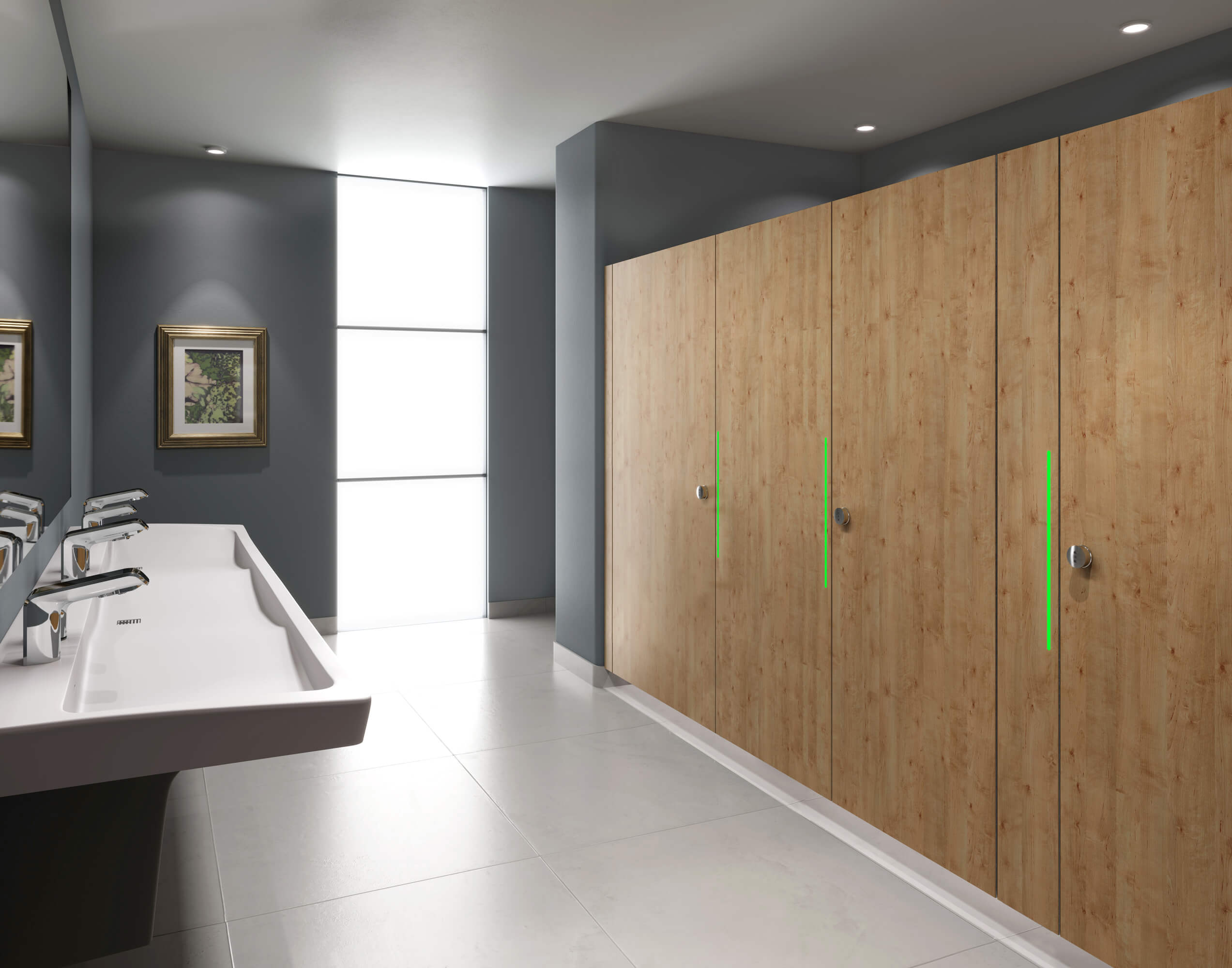
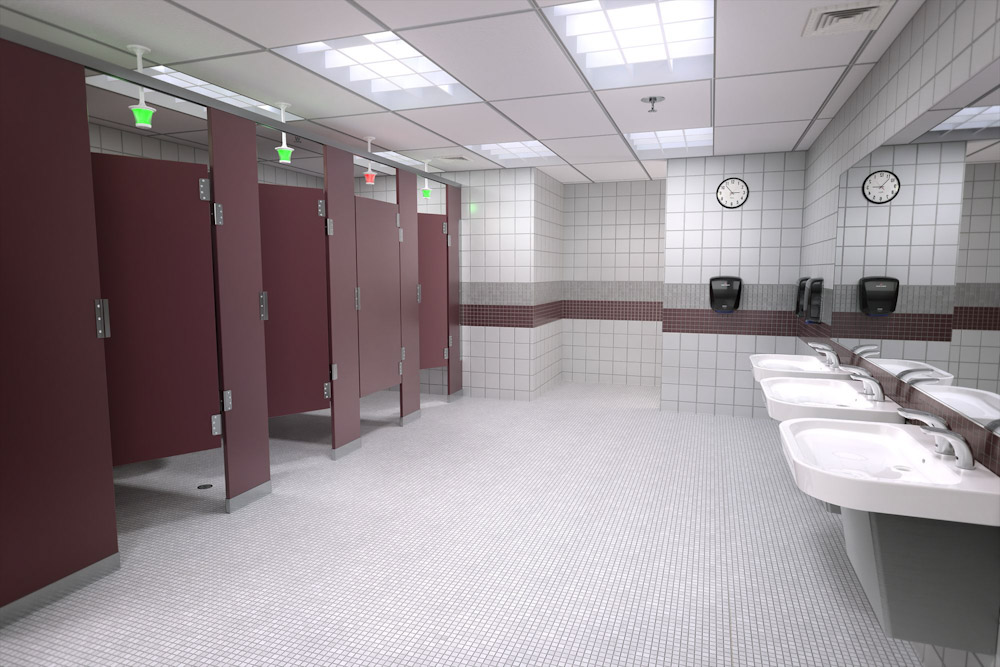
Ask three suppliers what commercial toilet partitions cost and you’ll get three numbers that seem to have nothing to do with each other. One quotes $800 a stall, another $2,700 — and neither is wrong. The difference is material, mounting, hardware, and what the quote actually includes.
This guide breaks down commercial toilet partition price the way an estimator does: by material, by stall, and by the variables that move the number. You’ll also see how pricing shifted from 2025 into 2026, what to expect in 2027, and how to compare supplier quotes so you’re comparing the same thing.
Overview of Commercial Toilet Partitions
Commercial toilet partitions are the panels, doors, and pilasters (the vertical posts) that divide a restroom into stalls. They’re a Division 10 specialty — specified in commercial construction under spec section 10 21 13 — and they show up in every office, school, restaurant, hotel, gym, and public building with a multi-user restroom.
Types of Toilet Partitions
Partitions are categorized by how they mount, and mounting style affects both price and installation labor:
- Overhead-braced (floor-mounted) — pilasters anchor to the floor and an aluminum headrail ties the tops together. The most common and most economical style, and the easiest retrofit.
- Floor-mounted (no headrail) — anchored at the floor only, for a cleaner sightline. Requires a thicker floor anchor, which can add cost in slab-on-grade or post-tension floors.
- Ceiling-hung — panels hang from structural steel above the ceiling, leaving the floor clear for mopping. The highest install cost because it needs overhead support coordination.
- Floor-to-ceiling — anchored at both ends for maximum rigidity in high-abuse restrooms. Mid-to-high install cost.
- European-style / full-height privacy — floor-to-ceiling panels with minimal sightline gaps. The fastest-growing segment and the most expensive, driven by tenant and employee demand for privacy.
Common Materials Used
Material drives price more than any other decision:
- Powder-coated steel — honeycomb-core steel panels with a baked enamel finish. The budget workhorse for offices, retail, and churches.
- Solid plastic (HDPE) — solid polymer through and through. Won’t rust, delaminate, or hold graffiti; the standard for schools, pools, and parks.
- Plastic laminate (HPL) — laminate over a particleboard core. Widest color range; keep it out of wet rooms.
- Solid phenolic — resin-impregnated layers pressed into a dense, moisture-resistant panel. Healthcare, airports, stadiums.
- Stainless steel — cleanable, vandal-resistant, premium appearance. Hotels and Class A office.
Factors Influencing Commercial Toilet Partition Price
Two restrooms with the same stall count can price 3x apart. Here’s where the money actually goes.
Material Quality and Type
Material is roughly 60–70% of a typical partition budget. The spread works like this: powder-coated steel is the baseline; solid plastic (HDPE) typically runs 50–60% above steel on the same multi-stall layout; stainless steel runs roughly double; and phenolic prices between HDPE and stainless depending on core and finish. Within each material, panel thickness, core type (honeycomb vs. solid), and finish tier move the number further.
Cheap material has a cost too. A laminate stall in a wet restroom delaminates in a few years; a steel stall in a pool area rusts. Matching material to the environment is the difference between a 10-year partition and a 25-year partition — which is why price per year of service is a better comparison than price per stall.
Design and Customization Options
Standard configurations in standard colors are the price floor. Each step away from standard adds cost:
- Custom colors and textures — special-order finishes add cost and lead time over a manufacturer’s stock color card.
- Full-height privacy options — no-sightline doors, continuous hinges, and occupancy indicators are increasingly requested and priced as upgrades on standard lines.
- Hardware tier — standard zamac or chrome hardware vs. stainless, tamper-resistant, or ADA-specific hardware.
- ADA-compliant stalls — every restroom needs at least one accessible stall, which uses more material (wider stall, outswing or larger door) and specific hardware. Budget accessible stalls at a premium over standard stalls. Layout requirements are covered in our ADA bathroom requirements guide.
Installation and Labor Costs
Supply-only and installed quotes are different products. Installation pricing depends on:
- Site conditions — retrofit work in an occupied building costs more than open new construction. Demolition and disposal of old partitions, out-of-plumb walls in older buildings, and tile or stone drilling all add labor.
- Access and hours — Manhattan freight elevator scheduling, after-hours work so a restroom can stay open during business hours, and union vs. open-shop requirements all move the number.
- Mounting style — ceiling-hung and floor-to-ceiling installs take longer than overhead-braced.
- Quantity — mobilization is fixed, so a one-stall replacement carries a higher per-stall install cost than a forty-stall project.
Because these variables stack differently on every job, we price installation together with the material quote rather than publishing a flat per-stall labor rate — send us the room and you’ll get one number that includes both.
Commercial Toilet Partition Price Trends
Comparing 2025 and 2026 Pricing
Partition pricing rose noticeably from 2025 into 2026, and the drivers were upstream of the manufacturers:
- Steel tariffs and metal costs. Expanded U.S. tariffs on imported steel and aluminum raised input costs for powder-coated steel, stainless steel, and the aluminum headrails and hardware used on every mounting style — so even plastic partitions felt it.
- Resin and laminate inputs. HDPE and phenolic track petrochemical and resin markets, which stayed elevated through 2025–2026.
- Freight. Partitions ship oversized and heavy; LTL freight costs remained a meaningful line item on every quoted job.
Most manufacturers passed these through as annual list-price increases, with steel-based lines seeing the sharpest moves.
Projected Prices for 2027
Expect continued moderate increases into 2027 rather than relief. Tariff policy on steel and aluminum remains in place, manufacturers have shown no signs of rolling back 2026 list increases, and full-height privacy products — which carry more material per stall — keep taking a larger share of orders, pulling the average project price upward even where list prices hold flat.
The practical takeaway: if a renovation is planned for 2027, pricing it in late 2026 and locking material early typically beats waiting. Pricing in our online partition planner is kept current, so you can re-price the same restroom today and again when you’re ready to order and see exactly where the number stands.
Factors Contributing to Price Changes
Beyond tariffs and inputs, three structural factors keep moving partition prices:
- Privacy expectations. Tenants and employers increasingly spec European-style or no-sightline stalls, which use more material and better hardware per stall.
- Vandalism and durability specs. Schools and public facilities continue shifting from steel and laminate toward HDPE and phenolic — a higher first cost that buyers accept for lower lifetime cost.
- Lead-time premiums. Quick-ship programs and in-stock material carry a modest premium over long-lead custom orders, but save weeks of schedule — often the cheaper choice once a delayed opening is priced in.
Cost Analysis by Stall
Commercial Toilet Partition Price Per Stall (2026)
Per-stall pricing is the most useful way to budget, because restrooms are quoted and compared that way. The ranges below are drawn from our current pricing for standard overhead-braced layouts in stock colors, supply only. Notice that the per-stall number drops sharply as stall count rises — a single-stall project carries the whole run’s pilasters, headrail, and freight on one stall:
| Material | Single-stall project | Per stall on 5–10 stall projects |
|---|---|---|
| Powder-coated steel | $1,750–$2,050 | $775–$860 |
| Solid plastic (HDPE) | $1,600–$2,475 | $1,225–$1,360 |
| Stainless steel | $2,075–$2,700 | $1,500–$1,700 |
Within each range, the layout sets the exact number: a between-walls run prices at the low end because the walls do some of the structural work, while a corner layout needs an extra pilaster and prices at the high end. Plastic laminate and phenolic pricing varies more by finish and core selection, so we quote those per configuration.
We deliberately don’t publish an exact price for every combination — there are too many, and a stale number helps no one. Instead, our online partition planner prices your exact material, layout, and stall count in a few minutes, any time, with current pricing — or call us and we’ll run it with you.
Breakdown of Costs Per Stall for Different Materials
Where the per-stall number comes from, using a standard overhead-braced stall as the example:
- Panels and door — the largest share, driven by material and thickness.
- Pilasters — one or two per stall depending on position in the run; corner and alcove layouts use fewer pilasters per stall than freestanding runs, which is why layout affects price.
- Hardware set — hinges, latch, strike/keeper, coat hook, and brackets. Standard hardware is included in the ranges above; stainless or tamper-resistant upgrades add per stall.
- Headrail and shoes — the aluminum rail and pilaster trim, priced by the linear foot of the run.
- Freight — allocated per stall, heavier for steel and phenolic than HDPE.
This is also why “price per stall” quotes from different suppliers can’t be compared blind — one may include freight and ADA hardware, another may not. Always compare the included scope, not just the number.
Finding the Right Supplier
Top Vendors for Commercial Toilet Partition Price in 2026
The manufacturers architects most commonly specify — and the lines we supply — include Bobrick, Bradley, ASI Accurate Partitions, Hadrian, Metpar, and Scranton Products. Each has a different sweet spot: some lead on steel value, others on HDPE durability or phenolic finish range.
The vendor name on the panel matters less than most buyers expect, though. Within a material class, major manufacturers price competitively with each other — the bigger price differences come from the distributor’s stock position, freight, and whether installation is bundled.
What to Look for in a Supplier
Price is one of five things to check:
- Stock vs. order-only. A supplier with physical inventory can replace a vandalized door this week; a catalog site quotes you a manufacturer lead time. Ask what’s actually on their floor — here’s what we stock for same-day pickup.
- Field measurement. Retrofit openings in older buildings rarely match nominal dimensions. A supplier who field-verifies before ordering prevents the expensive version of this lesson: a stall that doesn’t fit and a second lead time.
- Installation capability. Supply-and-install under one contract means one party owns the fit. If you’re buying supply-only, confirm the supplier provides drawings and phone support for your installer.
- ADA layout review. Your supplier should flag clearance and layout problems before you order, not after inspection.
- Submittals and shop drawings. If your project requires them — most commercial work does — confirm the supplier produces them rather than forwarding manufacturer cut sheets.
Requesting Quotes and Evaluating Options
To get a quote you can actually compare, send every supplier the same package: stall count, wall-to-wall dimensions, ceiling height, material preference, mounting style, and photos or a floor plan — even a phone photo of a sketch works. Our guide to measuring and ordering toilet partitions covers exactly what to capture.
Then line the quotes up on scope, not just total: Does each include freight? ADA hardware? Demolition and disposal? Installation, and if so, during what hours? A quote that’s $400 cheaper and excludes freight and disposal isn’t cheaper.
Understanding Commercial Toilet Partition Price: A Comprehensive Guide for Businesses: frequently asked questions
On multi-stall projects, current supply pricing runs from about $775–$860 per stall for powder-coated steel to $1,500–$1,700 for stainless steel, with HDPE in between. Single-stall projects price higher per stall, and installation, ADA stalls, and custom colors add from there. Our planner prices your exact layout instantly.
Powder-coated steel is the most economical commercial partition material — typically 35–40% less than solid plastic (HDPE) for the same multi-stall layout. It’s the right choice for dry, ventilated restrooms in offices, retail, and churches, but not for pools or wash-down environments.
Installation depends on site conditions more than material — occupied-building retrofits, after-hours work, and ceiling-hung mounting all add labor. We quote installation together with the material so you get one complete number for the room instead of a labor rate that shifts later.
Unlikely. Steel and aluminum tariffs, elevated resin costs, and growing demand for full-height privacy partitions all point to continued moderate increases. If your project is planned for 2027, pricing it in late 2026 generally works in your favor.
Count the toilets, confirm at least one ADA-accessible stall per restroom, and measure wall-to-wall width and room depth. With those numbers and a photo, a supplier can quote the full restroom — stall count alone isn’t enough, because layout determines pilaster count and panel sizes.
Get a real number for your restroom
Ranges budget a project; a quote prices one. The fastest route is our online partition planner — pick your material, layout, and stall count and it prices your restroom in minutes, any time, with current pricing. Prefer to talk it through, or need installed pricing? Send us your stall count, dimensions, or drawings and we’ll return a complete quote with current lead times — usually the same business day. In-stock steel and stainless stalls are available for same-day pickup at our Long Island City warehouse.
Price your restroom in the planner, call (718) 874-3805, or email info@mavinewyork.com with your plans attached.