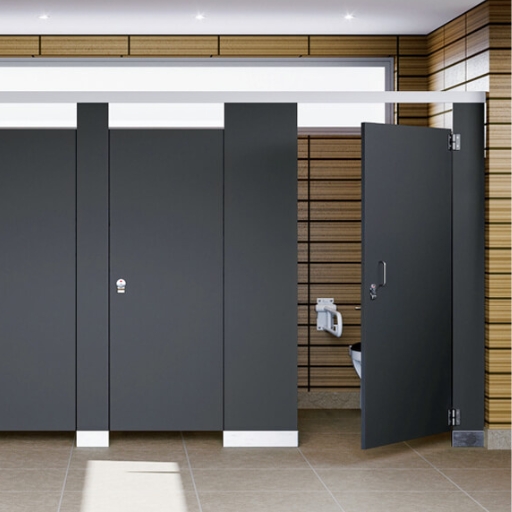
Installing Toilet Partitions
Watch this short installation video completely to ensure proper installation. We are ready to solve your any installation difficulties.
Powder Coated Installation PDF
Solid Plastic Installation PDF
Stainless Steel Installation PDF
Frequently Asked Questions: Metal Toilet Partition Installation Instructions
To properly install standard series metal restroom compartments, you will need a variety of tools including a 4-foot level, chalk line, tape measure, hammer, hammer drill with 5/16″ and 1/4″ masonry bits, an adjustable wrench, 7/16″ and 1/2″ wrenches, a hacksaw, 6-lobe security driver bits, a “C” clamp, and a 12-inch shim block to rest panels on for easier installation.
To establish the front centerline for your floor brackets, take the overall compartment dimension and deduct 5/8″. For exact pilaster locations along this line, always refer to your final layout drawings.
When erecting panels and wall pilasters, the centers for the 2-ear panel brackets and single-ear pilaster “F” brackets should be positioned at approximately 18 inches and 64 inches from the floor. You may need to adjust these heights slightly based on masonry lines or varying floor conditions.
Headrail brackets should be fastened to the wall approximately 81.5 inches (2070mm) above the finished floor. As with wall brackets, some minor adjustments may be necessary depending on your specific floor conditions.
Yes. Both ceiling-hung and floor-to-ceiling toilet partitions require an overhead structural member (normally a channel) to be properly secured. Please note that this structural steel or pre-cast concrete member must be supplied, installed, and drilled by others prior to the application of the finished ceiling. Wood support is not acceptable.
For out-swing doors, you should install the surface-mounted latch 1/2″ (13mm) from the edge of the door. Ensure that you install the Stop & Latch Keeper so that it catches a maximum of 3/8″ (10mm). This exact catch position is highly important because it allows the door to be lifted for emergency access.
You should rest the panel on a 12-inch (305mm) shim block to position it in the brackets. It is highly recommended to keep the panel resting on this stabilizer block until the corresponding pilaster has been fully installed.
When preparing the pilaster, install the lower hinge and set the wing nut to the bottom of the screw, positioning the hinge assembly on a 45-degree angle into the pre-drilled hole. When using a continuous hinge, fasten the screws starting from the top of the hinge down to the bottom, ensuring the hinge is installed perfectly plumb so the door functions correctly.